

SETTING THE SCENE
A 20% pay rise sounds impressive. But is it?
With graduates typically starting their first roles in recruitment and executive search across August and September, the next few months are a busy season for pay and performance reviews — particularly for those reaching their 1, 2 and 3-year work anniversaries.
But if you’ve only ever worked at one firm, how do you know your market worth? And how do you know whether the pay increase you’re being offered is actually as good as it sounds?
A 20% uplift on a below-market-average salary sounds good — but it may still mean you’re being undervalued.
This briefing sets out current benchmarking and how salaries typically develop over the first few years of a career in recruitment and executive search, using four illustrative profiles: two contingent recruiters and two executive search researchers.
Graduate starting salaries
We don’t cover graduate hiring ourselves, but we partner with firms that do — please get in touch if you’d like an introduction. From our research:
The ~£10k gap comes down to financial model, not candidate quality. Lower bases in contingent firms are typically boosted by uncapped commission, with an expectation you’ll be billing quickly. Higher bases in executive search usually carry an annual bonus capped as a percentage of base, with no individual billing target — instead you’re assessed on research quality and input into the search process.
YEAR ONE
Four profiles, one year in
To illustrate how these models play out, we follow two contingent recruiters and two executive search researchers through their first two years.
Two firm types, two very different paths to the same finish line.

End of year 1 review
Contingent reviews focus primarily on billing; most firms expect ~4x base by year two. Executive search reviews focus on the shift from research support toward owning parts of the search process.

THE CATCH
Despite performance levels, Recruiter B – who billed less than Recruiter A – ends the year earning more, purely because they started on a higher base. By the end of Year 1, the spread between the highest and lowest earner has grown to £10.5k.
YEAR TWO
Performance starts to bite
By year two, contingent recruiters are expected to be building their own desk, while executive search researchers begin taking ownership of end-to-end searches — this is where firms start to get real value from them.
Year two is where the climb steepens — and the gap between profiles starts to show.

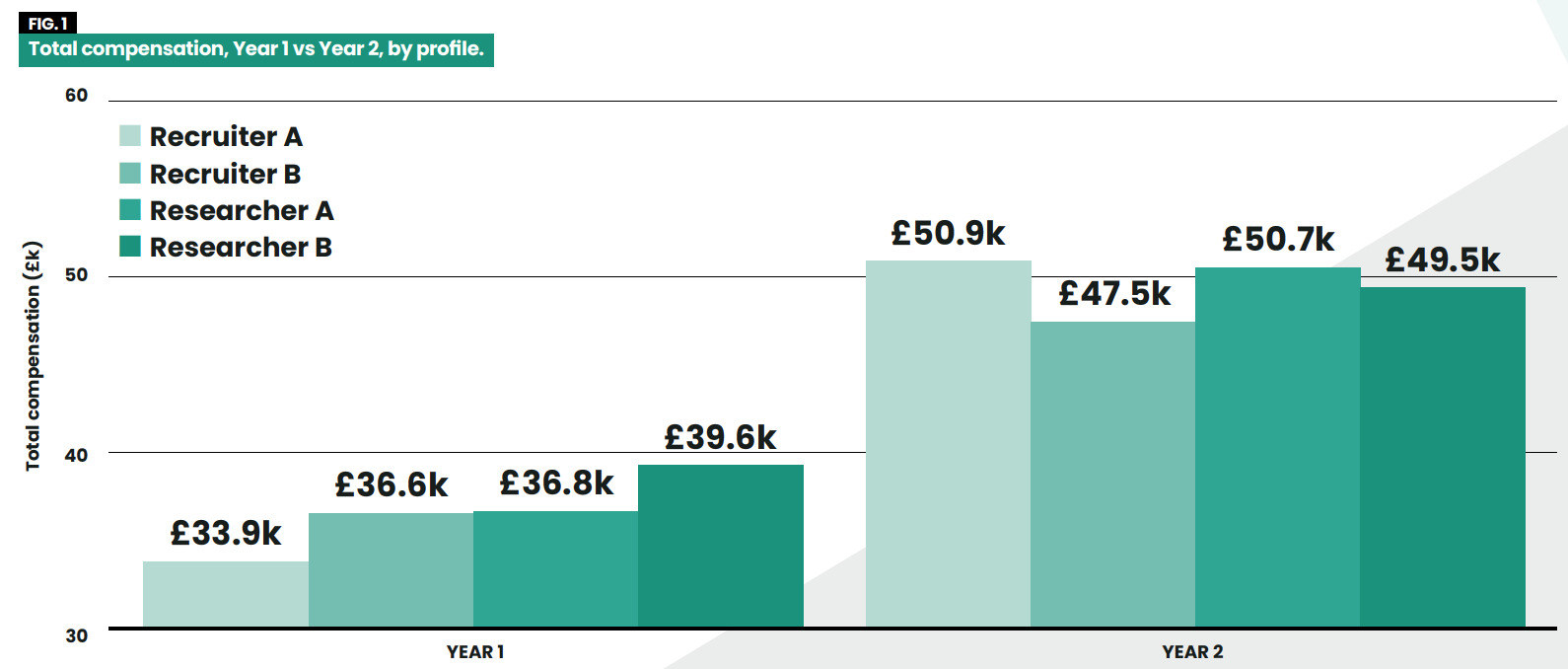
END OF YEAR TWO — TIME FOR REFLECTION
This is where things get interesting
Two stay. Two decide the view is better somewhere else.
Recruiter A agrees to a target 25–30% higher (£180k). Base rises by £3k to £40k, OTE £60k. Enjoying contingent recruitment, they decide to stay.
Recruiter B is also set a £180k target, with just a £1k base increase to £40k. Having struggled with business development, they decide to go to market for a move into executive search.
Researcher A is in high demand. To retain them, base rises 10% to £47k; with a 20% bonus, OTE is £57k. They decide to stay.
Researcher B feels their career is stalling — their bonus lagged their peers. They decide to go to market.
What could Recruiter B and Researcher B achieve by moving?

Researcher B — not seen as a top performer internally — could realistically out-earn Researcher A, the standout high performer, simply by moving to a firm paying closer to market rate.
THE VERDICT
So, is a 20% pay rise actually good?
The scenarios above highlight the importance of your base salary. A 20% pay rise sounds impressive — but if you’re starting from a below-market base, you may still be behind where you should be.
The quicker your base salary aligns with the market, the better — particularly as responsibilities change and pension contributions, mortgages and other financial commitments become part of the conversation.
Your pay rise should be considered in the context of:
- Your current base salary
- Your performance
- Your responsibilities
- Your billing or contribution
- Your total compensation
- The market rate for someone with your experience
- Your future earning potential
THE KEY QUESTION
Not “what percentage pay rise am I getting?” — but “what am I worth in the market, and how does my current package compare?”
Talk to Us
If this has raised questions about your current base salary or earning potential — as a candidate or as a firm reviewing your compensation structure — get in touch for a confidential conversation.
Daniel Flynn, Managing Partner, 07900 803795
Daniel Close, Managing Partner, 07377 420429, dc@drydensearch.com
0 Comments
Leave a comment